
TV Above a Fireplace in Lake Forest
TV Mounting Point Lake Forest covers TV mounting over the mantel in Lake Forest — the stacked-stone great-room fireplaces of Portola Hills and Foothill Ranch, the brick hearths of the 1970s El Toro tracts and the drywall chimney chases of Baker Ranch — where the surface decides the anchor, a hand on the wall after an evening fire decides the height, and the seat decides whether the screen must come down to watch.
Bookings aren't open yet. Leave your name and number; your message is recorded, and you'll get one message when a local installer is available.
 Illustration
TV Above a Fireplace in Lake Forest, CA typically runs $169–$539 per TV in our 2027 estimator, depending on the TV size and the wall type. Use the estimator below for your own numbers.
What the fireplace face is made of
Three surfaces cover almost every Lake Forest fireplace, and each one is drilled and fixed differently.
- Thin ledger-stone panels. Common in the hillside great rooms built in the 1990s and 2000s. The stone is often a veneer about an inch thick glued over cement board, so the installer bores a small test hole first; if wood framing sits behind, long screws go through the veneer into it, and if the stone is full-depth, sleeve anchors go into the solid pieces.
- Brick. Found in older tract living rooms around El Toro. Anchors are set in the face of whole bricks, a bolt's width away from any edge.
- Painted drywall over a framed chase. Typical of newer homes such as those in Baker Ranch that use a gas insert. Lag bolts go into the chase framing exactly as on any interior wall.
What the numbers show
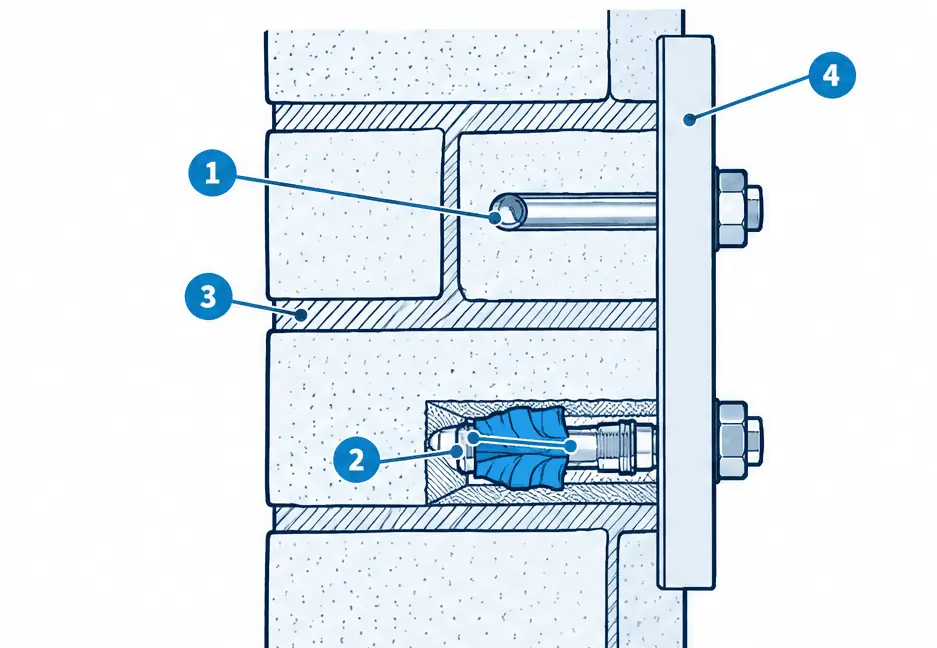
- Hole in the brick body Each hole is bored into a whole brick or stone, clear of the joints.
- Expanding sleeve Turning the bolt drives a cone that spreads the sleeve against the masonry.
- Mortar joint The joint material is too weak to hold an anchor under load.
- Wall plate Tightened anchors pull the plate flat onto the masonry face.
Heat, gas inserts and a mount that comes down
Most Lake Forest fireplaces burn gas today, and a gas insert can push a plume of warm air straight up the face. Before the plate goes on, the installer asks for the fireplace to be run for a while, then checks the wall where the TV would hang; if it is too warm to keep a palm on comfortably, the screen goes higher, a deeper mantel is used as a shield, or the plan changes.
The TV maker's manual lists the operating temperature and the insert's manual lists the clearance to combustibles; the stricter of the two wins. Where the safe position is uncomfortably high for the sofa, a pull-down arm stores the screen above the mantel and draws it out and down for a film, passing in front of the mantel shelf.
What the numbers show
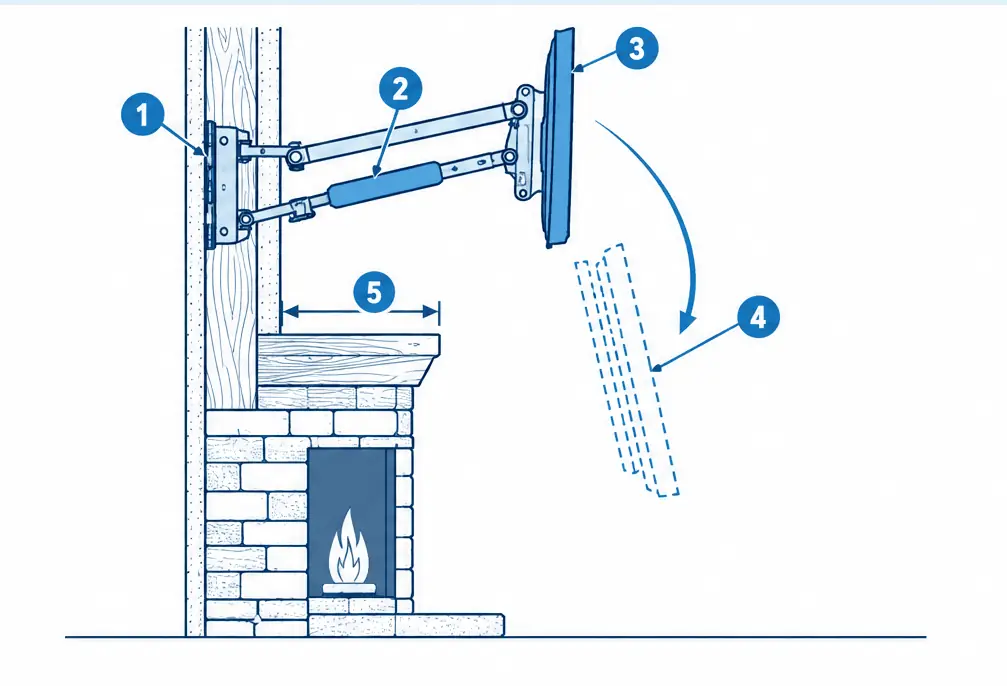
- Wall bracket in the framing Bolts hold the bracket in the framing over the mantel, never in the firebox surround by itself.
- Gas-spring arms Two linked arms with gas cylinders balance the weight of the set as it moves.
- Parked position When nobody is watching, the screen stays high, clear of the warm air.
- Lowered position The dotted shape is the TV drawn forward and down for viewing.
- Mantel clearance The arc of travel passes in front of the mantel edge, marked by its depth line.
Routing cables across masonry
Stone and brick are not cut open for a cable. The options are, in order of preference:
- A short run sideways into the drywall beside the chimney, then down inside that wall with in-wall rated parts to a cabinet.
- A slim raceway, painted to match, tucked into the corner where the masonry meets the wall.
- A media box on the mantel or a wireless video kit, so only the TV's power cord rises.
The power cord stays on the outside unless an electrician fits an outlet behind the screen; that is a permitted electrical job, never part of the mounting. Nobody drills near the flue or the gas valve.
Before a fireplace refacing
Homeowners in the older tracts often swap brick for ledger stone during a kitchen-and-family-room remodel. That is the cheapest moment to plan the TV, because the contractor can set wood blocking, a recessed power-and-signal box and a conduit to the cabinet before the stone is glued on. Once the stone is up, the only routes left are on the surface.
TV Above a Fireplace — common questions
What does a TV over a fireplace cost in Lake Forest?
For a 32–49 inch set on a drywall chase, roughly $169–$259 in 2027; a stone or brick face adds $50–$95 to that.
Is a gas insert safer for a TV than a wood fire?
Not automatically; many inserts blow warm air up the wall, so the wall is checked after the insert has been running before a height is chosen.
Do I need a pull-down mount?
Only when the safe height leaves the picture too high for the seats; otherwise a tilting mount is enough.
Availability & price range
TV Above a Fireplace: check availability and price range
Bookings aren't open yet — answer a few quick questions about the TV and the wall and get a typical Lake Forest price range right here. Typical Lake Forest prices for one TV, labor only unless an option says otherwise. This is a market estimate, not a quote.