
Project example: a 55-inch TV in a bright living room, placed to avoid glare from a wide slider — what it looks like and what it costs
TV Mounting Point Lake Forest walks through a typical living-room project in Lake Forest Keys: a 55-inch TV on a tilting mount on the wall opposite a wide slider, placed after the glare is checked, with the association's rules read first and a soundbar on its own bracket.
Bookings aren't open yet. Leave your name and number; your message is recorded, and you'll get one message when a local installer is available.
Worked example. The pictures are AI concept illustrations, not photographs; no installation was performed or arranged through this site; prices are typical Lake Forest area market ranges, not quotes.
 Illustration
Project Examples & Typical Prices
The scenario
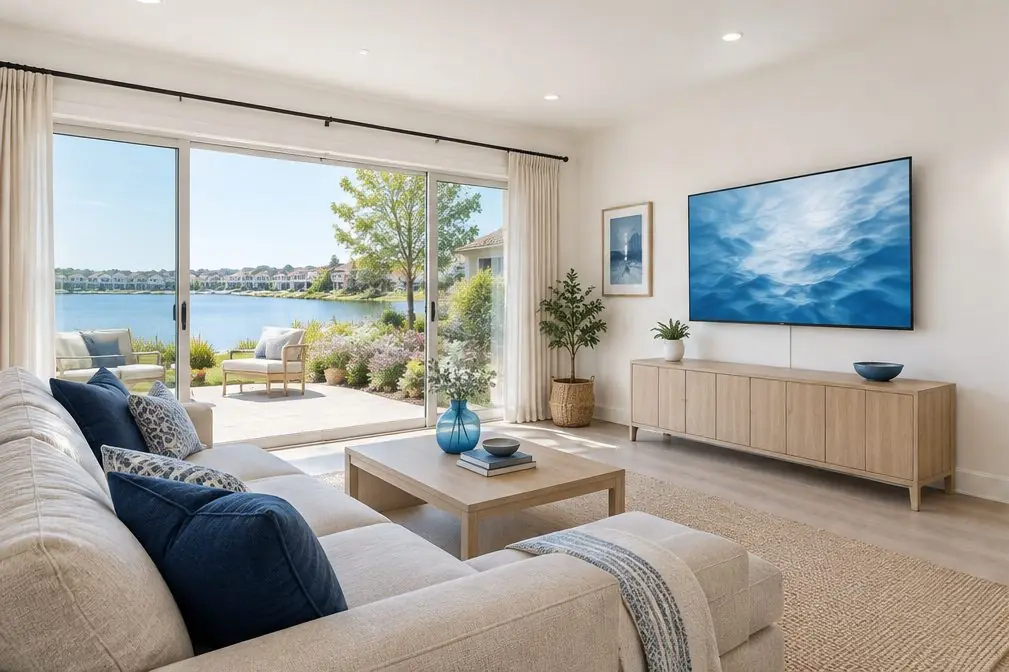
The home is a house in a lake community with a living room that opens to a small patio through a wide sliding door. On the opposite wall, between the kitchen and the stairs, there is a clear stretch of drywall where a console stands. In the afternoon the light through the glass reaches deep into the room.
The request is a 55-inch TV on that wall that can be seen from the sofa without a washed-out picture, with a soundbar below it and no cord showing. Everything stays inside the house, away from exterior, patio and balcony walls; the management office has still been told about the visit and the contractor hours.
The sofa faces the patio, so anyone watching TV there would have their back to the garden. The household therefore keeps the TV on the opposite wall and uses the slider as the room's natural light. A narrow console already stands there, and the soundbar is meant to sit below the screen without crowding it.
What the job involves
- The installer sits on the sofa at the hour the household watches most and holds a sheet of matte board against the wall to see which reflections reach the screen.
- The wall opposite the slider wins; tape outlines the screen there and the center is set near the seated eye line.
- A finder and a probe hole prove two stud edges, and the plate is fixed with lag bolts after pilot holes.
- The tilting arm and the TV go on; the tilt is set a few degrees toward the seats and the lock screws are tightened.
- The bar's own bracket goes into studs at an even gap under the screen and is checked with a laser line before the bar is hung.
- Cables run through a slim raceway to the outlet; the household is shown how to adjust the tilt for evening and daylight viewing.
Hardware and materials
- Tilting mount rated for 40–70 inch panels with a short extension
- A separate soundbar bracket sized to the bar's weight
- A laser line level to set the bar parallel to the screen
- Pilot-hole bit, lag bolts and washers
- A glare card: a sheet of matte board held at the wall to preview reflections
What it typically costs in the Lake Forest area
| 50–65 inch TV, standard wall mount (labor) | $119–$175 |
| Mount a soundbar as well | +$50–$80 |
| Typical total | $169–$255 (market range, not a quote) |
These are typical local ranges, not a quote or an offer; an installer prices the actual job after seeing the wall.
Add-ons often paired with this job
- Hide the wires inside the wall — +$90–$155. In-wall rated parts could replace the raceway on this interior wall.
- Full-motion (articulating) mount — +$30–$50. An arm could swing the screen toward the kitchen.
- Take down an existing TV first — +$40–$85. An older TV is taken down as a separate line.
Why it is done this way
With a wide slider the room is bright, so the wall opposite the glass wins over the wall with the nicest console. A few degrees of tilt handle the rest.
Keeping the install on an interior wall keeps it away from the exterior walls that the architectural rules of the association cover. If the plan had included a patio screen, the current rules and any approval form would be checked first.
With a wall of glass the question is less about the wall and more about light. A screen across from a wide slider will see reflections at some hour of the day, and the installer's job is to find the position and tilt that tolerate them.
The soundbar gets its own bracket so the gap stays even if the TV is tilted later. Both items stay inside the house, which is why the association's exterior rules are not part of this scenario.
What would change the price
- The slider faces west, and the TV moves to a shaded wall or gets a deeper tilt.
- The studs are off-center behind the console, and a wider plate or a backer board is used.
- The household asks for a patio TV as well, which first needs the association's current rules and any approval form.
- A larger set moves the base range to the next size tier.
- The association asks for a contractor registration or fee, which is not part of the range.
Where this leads
- Service page: Lakeside Community & HOA TV Mounting — Homes near the private lakes, where the association's rules matter most for anything seen from outside.
- Local page: TV mounting in Lake Forest Keys
- All services and typical prices: TV mounting in Lake Forest
- More worked examples: Project Examples & Typical Prices
Availability & price range
Check availability and the price range for this setup
Bookings aren't open yet — answer a few quick questions about the TV and the wall and get a typical Lake Forest price range right here. Typical Lake Forest prices for one TV, labor only unless an option says otherwise. This is a market estimate, not a quote.