
Project example: a 55-inch TV on an older plaster wall in an El Toro ranch house — what it looks like and what it costs
TV Mounting Point Lake Forest looks at a typical plaster-wall project in an older El Toro ranch house: a 55-inch TV on a fixed mount fastened into the studs behind the plaster, with slow drilling, tape on the finish and the cords tucked into a paintable raceway to the outlet that is already there.
Bookings aren't open yet. Leave your name and number; your message is recorded, and you'll get one message when a local installer is available.
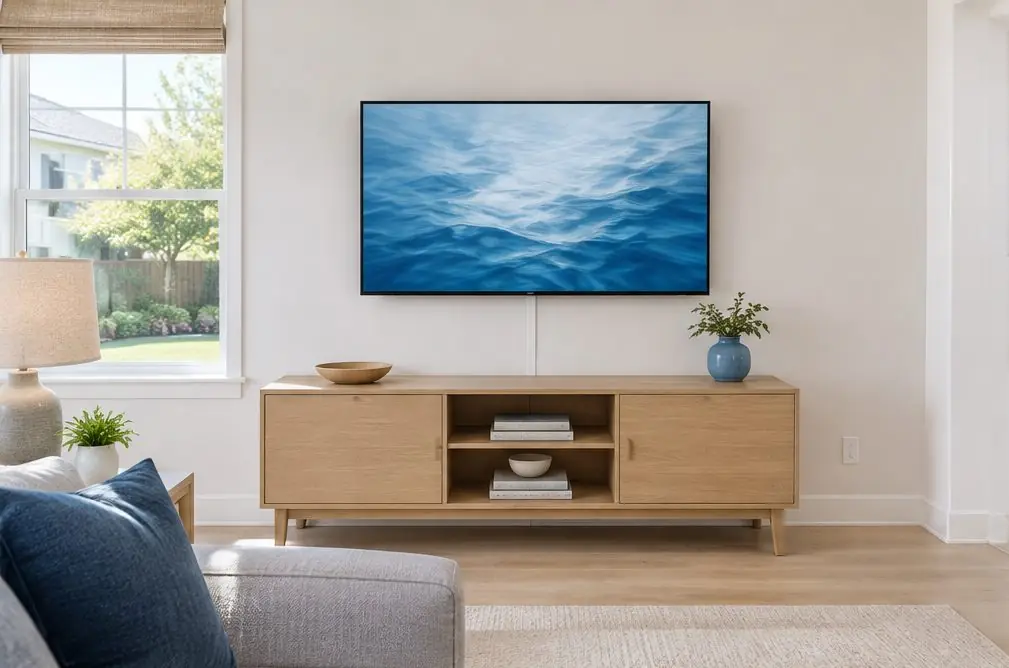
Worked example. The pictures are AI concept illustrations, not photographs; no installation was performed or arranged through this site; prices are typical Lake Forest area market ranges, not quotes.
 Illustration
Project Examples & Typical Prices
The scenario
The house is a single-story ranch on one of the older streets, with a living room that has been repainted several times. One wall is original plaster; the room has a window on one side and a low sideboard under the wall in question. A single duplex outlet sits near the floor, a few feet to the right of where the TV would go.
The request is a 55-inch TV centered over the sideboard, with no cord hanging down and no cracked plaster. Plaster is hard and brittle, and the lath behind it hides studs from many finders, so the job is slow by design: the bit goes in gently, the studs are proved with test holes and the bolts are longer than for drywall.
The sideboard is a family piece and stays where it is, so the screen is centered over it rather than over the wall. A picture window on the left brings morning light across the room, and a ceiling light with a dimmer sits above the sofa. The previous owner patched the wall once near the corner, which is why the test holes matter.
What the job involves
- The installer outlines the screen on the wall with painter's tape and sits on the sofa to check the height, since the center belongs near the seated eye line.
- A stud finder gives a first guess; small test holes with a thin bit, drilled with the hammer off, prove the stud edges behind the plaster and lath.
- Tape is laid over each drill spot, and pilot holes are drilled with a carbide bit at low speed to keep the plaster from chipping.
- The wall plate is held with long lag bolts that pass through the plaster and lath and bite deep into the studs, then leveled before the last turn.
- The brackets are fixed to the TV, the set is hung and locked, and the level is checked again with the weight on.
- The cords are tucked into a slim raceway running straight down to the existing outlet, ready for the owner to paint to match.
- The installer vacuums the dust and puts a bead of paintable caulk along the raceway edges, so the cover reads as part of the wall.
Hardware and materials
- Fixed low-profile mount rated for 40–70 inch panels
- Long lag bolts with washers for the thicker plaster-and-lath wall
- Carbide-tipped bit, a variable-speed drill and painter's tape
- Stud finder, laser level and a thin probe bit
- Paintable surface raceway with a cover for the cords
What it typically costs in the Lake Forest area
| 50–65 inch TV, standard wall mount (labor) | $119–$175 |
| Plaster over lath (some older El Toro-era homes) | +$25–$45 |
| Typical total | $144–$220 (market range, not a quote) |
These are typical local ranges, not a quote or an offer; an installer prices the actual job after seeing the wall.
Add-ons often paired with this job
- Hide the wires inside the wall — +$90–$155. Opening a plaster wall for wires is a repair risk; a raceway is the usual choice here.
- Mount a soundbar as well — +$50–$80. A bar on its own bracket is fixed into the same studs.
- Take down an existing TV first — +$40–$85. An older TV is taken down and its holes filled as a separate line.
Why it is done this way
On plaster the damage comes from speed, not from the weight of the TV. Slow drilling, tape on the finish and test holes cost a few minutes and avoid a repair that costs far more.
The raceway is chosen because cutting into plaster to hide cords leaves a patch that rarely matches. The cords still reach the outlet that is already there, and no new wiring is added.
Houses on the older streets have usually been repainted many times and sometimes re-textured, so a wall that looks like drywall can be plaster underneath a skim coat. The test hole answers the question in a minute, and the answer changes the bit, the speed and the bolt length.
The owner paints the raceway, which keeps the labor in the typical range and the finish in the owner's hands. Where a patched corner sits behind the planned plate, a short backer board or a wider plate avoids bolting into the patch.
What would change the price
- The test holes find no stud where the screen is centered, and a wider plate or a backer board is used.
- The wall is plaster over masonry rather than lath, and masonry anchors replace lag bolts.
- The raceway has to run across a doorway to the only outlet, and it gets longer.
- The plaster is already cracked near the plate, and the owner decides to patch before the mount goes up.
- A larger set moves the base range to the next size tier.
Where this leads
- Service page: TV Wall Mounting — Fixed or tilting mount set into the studs, with the wall checked first and the cords left tidy.
- Local page: TV mounting in El Toro
- All services and typical prices: TV mounting in Lake Forest
- More worked examples: Project Examples & Typical Prices
Availability & price range
Check availability and the price range for this setup
Bookings aren't open yet — answer a few quick questions about the TV and the wall and get a typical Lake Forest price range right here. Typical Lake Forest prices for one TV, labor only unless an option says otherwise. This is a market estimate, not a quote.