
Project example: a 65-inch TV on a tilting mount in a pre-wired great-room niche — what it looks like and what it costs
TV Mounting Point Lake Forest walks through a typical niche project in a newer Baker Ranch great room: a 65-inch TV on a tilting mount over a framed, pre-wired niche that sits above eye level, with the existing boxes matched to the plate and the cables hidden.
Bookings aren't open yet. Leave your name and number; your message is recorded, and you'll get one message when a local installer is available.
Worked example. The pictures are AI concept illustrations, not photographs; no installation was performed or arranged through this site; prices are typical Lake Forest area market ranges, not quotes.
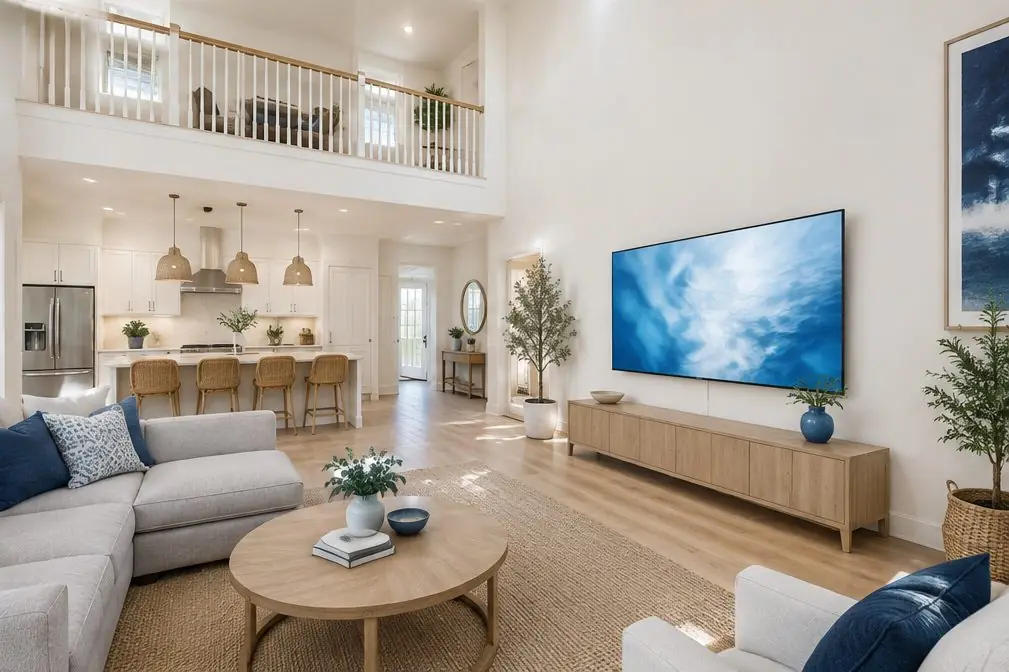 Illustration
Project Examples & Typical Prices
The scenario
The room is an open great room that joins a kitchen and a dining area. On the feature wall a rectangular niche was framed by the builder, with a power box and an HDMI box behind it, and the opening sits higher than a seated viewer's eyes. A gray sectional faces the wall and a kitchen island sits to the right.
The request is a 65-inch TV that fits the niche, can be watched from the sectional without leaning back and can also be seen from the island. The boxes behind it must be used and no cord may show. A tilting mount does the first job, and the existing boxes do the second.
The home is a few years old and the structured-wiring panel sits in a hall closet; the niche boxes feed a home run to it. The builder's design placed the niche at a height that looks right in the showroom, but the household sits lower on a deep sectional. Two stools at the island get a side view of the screen, and the kitchen pendants throw reflections at night.
What the job involves
- The installer measures the niche opening and the TV, then checks where the power and HDMI boxes sit behind the screen.
- A probe through the box opening shows the framing behind; the plate position is chosen so its bolts fall into solid wood.
- Tape on the wall shows the lowered screen position and the tilt needed; the installer checks it from the sectional and from the island stool.
- The tilting plate is fixed with lag bolts into framing, with a plywood backer added where studs miss the holes.
- The TV is hung and locked, and an in-wall rated plate for the boxes is fitted so the power and HDMI cables reach the screen without a cord showing.
- The tilt is set, the picture is checked for glare from the adjacent window, and the lock screws are tightened.
- The installer labels both ends of the HDMI cable and the power lead, so the panel in the hall closet stays readable later.
Hardware and materials
- Tilting mount rated for 50–75 inch panels
- Lag bolts, washers and a plywood backer panel where needed
- Recessed-box plate that matches the existing power and HDMI boxes
- CL3-rated HDMI cable and a short TV power cord
- Laser level, stud finder and painter's tape
What it typically costs in the Lake Forest area
| 50–65 inch TV, standard wall mount (labor) | $119–$175 |
| Hide the wires inside the wall | +$90–$155 |
| Typical total | $209–$330 (market range, not a quote) |
These are typical local ranges, not a quote or an offer; an installer prices the actual job after seeing the wall.
Add-ons often paired with this job
- Full-motion (articulating) mount — +$30–$50. An arm would pull the screen toward the island, at the cost of a stronger anchor.
- Mount a soundbar as well — +$50–$80. A bar on its own bracket sits below the screen, clear of the tilt.
- Take down an existing TV first — +$40–$85. An older TV is taken down as a separate line.
Why it is done this way
A niche framed for a standard set is a convenience, but the opening sets the height and the boxes set the cable route. The installer works with what the builder left instead of against it.
The scenario includes hidden wiring because the boxes are already there; the add covers the plate, the in-wall rated parts and the time to match them.
A pre-wired niche saves a wiring job but dictates three numbers: where the plate bolts, how deep the mount can be and how the cable boxes line up behind the screen. The installer starts from those numbers and chooses the mount last.
The tilt is judged from the sectional first and the stools second. If the island seats matter a lot, a full-motion arm is the alternative, with the stronger anchor that comes with it.
What would change the price
- The boxes are not where the TV's ports are, and the plate or cable route changes.
- No studs fall behind the plate, and a backer board is fixed across the niche framing.
- A larger set does not fit the opening and hangs on the wall in front of it.
- The niche is deeper than expected and needs a deeper tilting arm.
- The wiring panel needs a patch cable or a different jack, which is separate low-voltage work.
Where this leads
- Service page: Great Room & Loft TV Mounting — Tall open-plan walls and framed niches, where the picture has to come down to the seats.
- Local page: TV mounting in Baker Ranch
- All services and typical prices: TV mounting in Lake Forest
- More worked examples: Project Examples & Typical Prices
Availability & price range
Check availability and the price range for this setup
Bookings aren't open yet — answer a few quick questions about the TV and the wall and get a typical Lake Forest price range right here. Typical Lake Forest prices for one TV, labor only unless an option says otherwise. This is a market estimate, not a quote.